
Let's talk drums!
I love talking about drums.
And I love everything about drums. How I was excited and scared at the same time when I was a little kid sitting at the side of the street waiting for the drum corps to march past me. The sound of a couple of dozen snare drums played in unison that you could feel through your whole body. I can talk for hours about drums, not only about playing them, but also about what is important for a drummer in order to be a great one. Also, the technical and historical side of it. How did it all start, and why are they made as they are. Yes, a total drum nerd, that’s me.
By the time I started thinking about how to make my first snare drum, I had learned how complex a snare drum is in terms of how all the components stack frequency waves on frequency waves. I also learned the hard way that a factory-made snare by a highly recommended drum brand can be a huge disappointment. A beautifully crafted snare made with the finest hardwood, by the top brand in the business, yet it did not sound particularly special and failed to inspire even after playing during a set. I couldn’t help trying to figure out why this was the case.
Discovering.
Being a musician, I also played other instruments, and at some point, I bought an acoustic guitar made by Tailor. I still have this guitar, and I often played it, resting my head on the side of the guitar to feel the acoustic vibration of it. Because this guitar has such a perfect and beautiful sound, I began to wonder why an acoustic drum could not do the same.
The most obvious observation was that the guitar had no heavy metal hardware bolted to its body, and you would not want to either. Even though an acoustic guitar is a complex build, it is just a hollow body that makes it possible to hear the strings when they vibrate. This principle is the same for the acoustic (snare) drums. Knowing how the snare drum started as a free-floating drum that was used during battles on the field, I could not comprehend why the snare drum evolved as it did. It was made more complex, and for some reason, metal parts were being bolted to the shell of the drum.
For reasons not known to me, there was a need for the top and bottom heads of the snare to be tuned individually. And at the same time, drum head manufacturers made special heads for the top and bottom, and these heads differ greatly from eachother. The bottom heads are much thinner than the top heads. Logic dictates that the bottom head will have a higher pitch than the top, even if the same amount of pressure is put on them.
The inspiration.
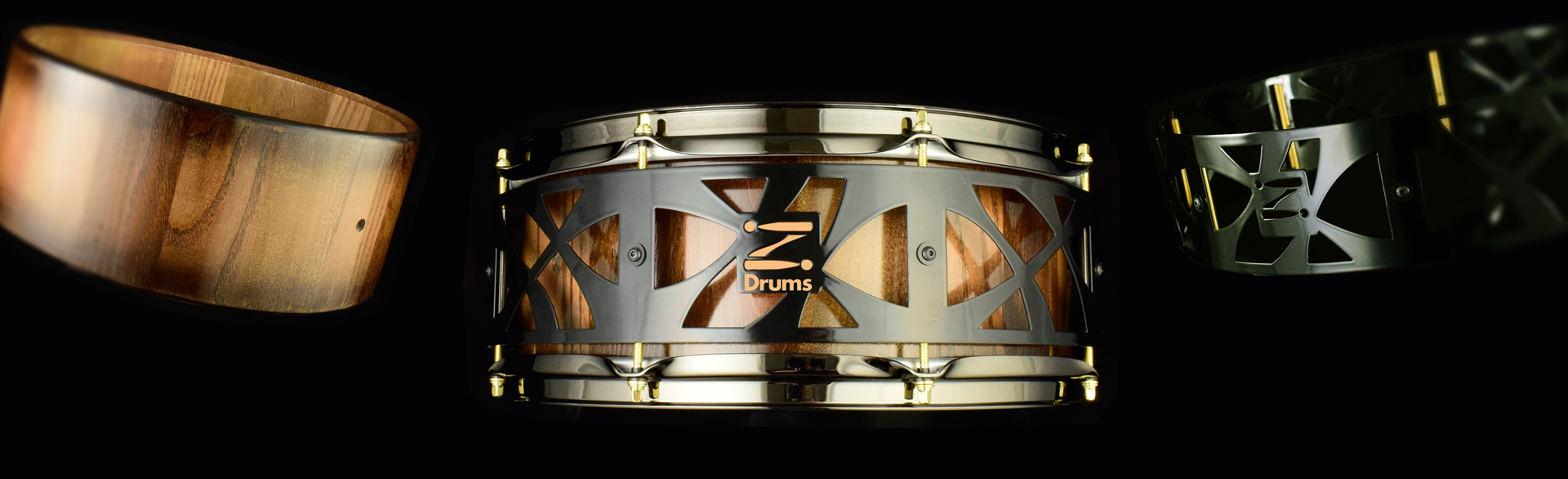
How I got the idea (from God) for the Z Drums fully free-floating snare drum is a long story, but the result is clear. By releasing the body of any metal hardware bolted to it, you end up with a simpler snare that lets the snare drum shell sing like never before. You get a full-bodied, rich sound, but what you don’t get is a ton of different overtones that conflict with each other. The top and bottom heads will equalise, but still have a difference in pitch. The cherry on top is the ease of tuning (not needed), and the head changes are the easiest ever, without the need to remove the snare beds.
Owning the best sounding snare ever in history (;-) has now become affordable too. The build is easier and quicker, any type of drum shell can be used, and it uses fewer bespoke hardware parts. The hardware-ring chassis from Z Drums can be used and bought separately, so you can upgrade your own snare. By improving the building process of stave shells, I reduced the cost of production, which means you can buy a blank stave snare drum shell for a reasonable and very competitive price, too.
Head over to the shop and build your own perfect-sounding snare drum.